
What the shadows reveal..
On Blackholes, Jung & karma | 12th March 2026
In this 'Ask Me Anything' session hosted by Nour, Bernardo was at his most wide-ranging and candid. From the genesis of alters, to the metacognition of nature, from the validity of evolution to the axioms of Aristotelian logic, the conversation ranged from black holes to karma, and the apparent contradictions in Jung's Seven Sermons to the Dead.
Evolution as shadow
Rebecca's question tackled a tension many members feel: if space-time is merely a cognitive filter, why take evolution so seriously?
Bernardo offered one of his most fundamental insights. Whilst spacetime is not fundamental, it reveals something that is.
If you illuminate a bottle from above, the shadow on the floor is a circle. The circle doesn't represent the full picture. But it does tell you something true: that there is a three-dimensional object whose cross-section, at that angle, is circular.
"The events in time are not the real thing, just like the shadow of the bottle is not the real thing, but they betray the presence of something that is real, and which, when projected onto the extension of space and time, appears to us as events."
Evolution, then, is valid within the world of shadows. To dismiss it because spacetime isn't fundamental is like refusing to look at the circle because it isn't the bottle. We live in the world of shadows, but taken seriously they reveal something real.
Karma Reflects Nature's Tendency to Learning
As for karma: Bernardo offers a naturalistic reading — not karma as cosmic justice, but as a teleological gradient in nature that tends to favour learning. If you mistreat others, it may reflect a lack of empathy for their perspective; a nature oriented toward maximising understanding might then place you in that perspective. It can look like justice — but it may have nothing to do with it.
Does the daemonic chaos of mind at large disrupt our shared dashboard of physical reality? Yes, all the time — in the form of anxiety, depression, impulses we can't explain. Our perceptual systems evolved over four billion years to filter out precisely that which is unpredictable and therefore useless for survival. The daemonic doesn't appear on the dashboard not because it's absent, but because we never evolved the sensors to amplify it.
Black holes as self-bounded mental processes
Reuben asked whether, under analytic idealism, a black hole might be understood as a self-limiting mental process whose boundary arises from its own internal consistency rather than external constraint.
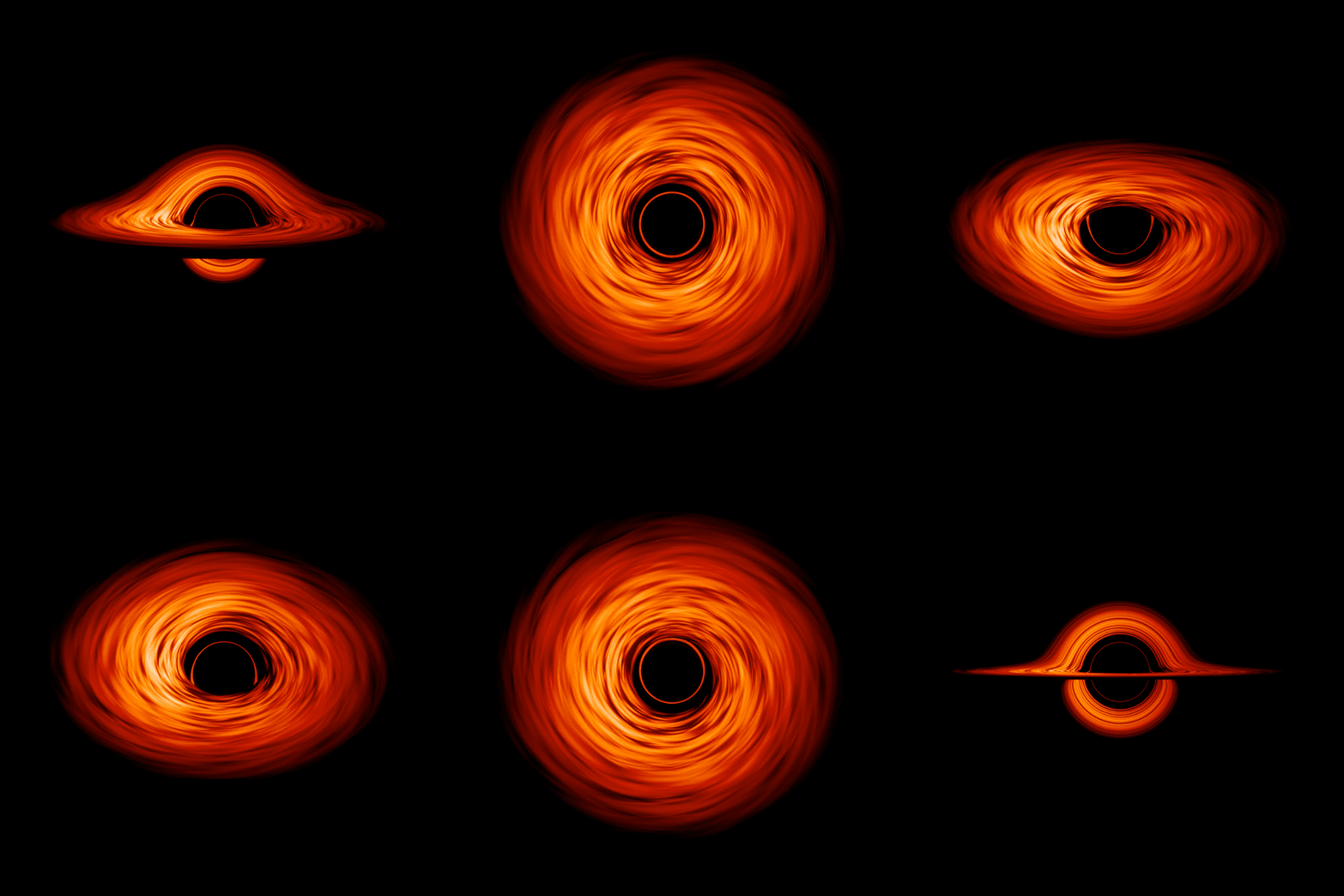
Bernardo found the framing compelling. He discussed serious speculation in cosmology that every black hole may be a universe unto itself — and the related possibility, now slightly dented by recent data on galactic angular momentum, that we ourselves are inside a black hole. He expressed regret that the evidence for this view has weakened, calling the combination of black-hole cosmology and the holographic principle "a very elegant idea."
"I'm completely daemonic in this regard"
Anna's question about Bernardo's study methods and extraordinary recall drew a characteristically self-deprecating answer. He has no system, no mnemonics, no planning. He dog-ears pages and writes in margins.
His explanation: philosophy was never an academic exercise for him — it was a search for an operating system for his life. When physicalism collapsed under scrutiny, he felt in freefall. Everything he has written, he first had to convince himself of. And you can't cheat yourself.
"I am the first customer of everything I have ever written. By the time I sit to write, I've already gone through the entire exercise — not because I'm disciplined, but because I can't deceive myself."
"There is not one serious defender of materialism today"
Ron brought up the reaction his sharing of Bernardo's now-circulating clip had provoked — the accusation that "no serious materialists" is a No True Scotsman fallacy.
Bernardo stood behind the statement while accepting the critique of its rhetorical framing. His definition of 'serious' is specific: someone who, in a private conversation with no audience and no career at stake, would say without reservation that physicalism is ontologically true. He hasn't encountered one in about ten years.
The broader exchange led into a sharp distinction between science (which models behaviour, not being) and metaphysics (which asks what is). Both Newtonian gravity and Einsteinian spacetime are, in Bernardo's framing, convenient fictions — instrumentally useful, not ontologically definitive. Any scientist who believes otherwise, he suggested, "does not understand what science is."
Jung's circumambulation; non-linear approach to truth
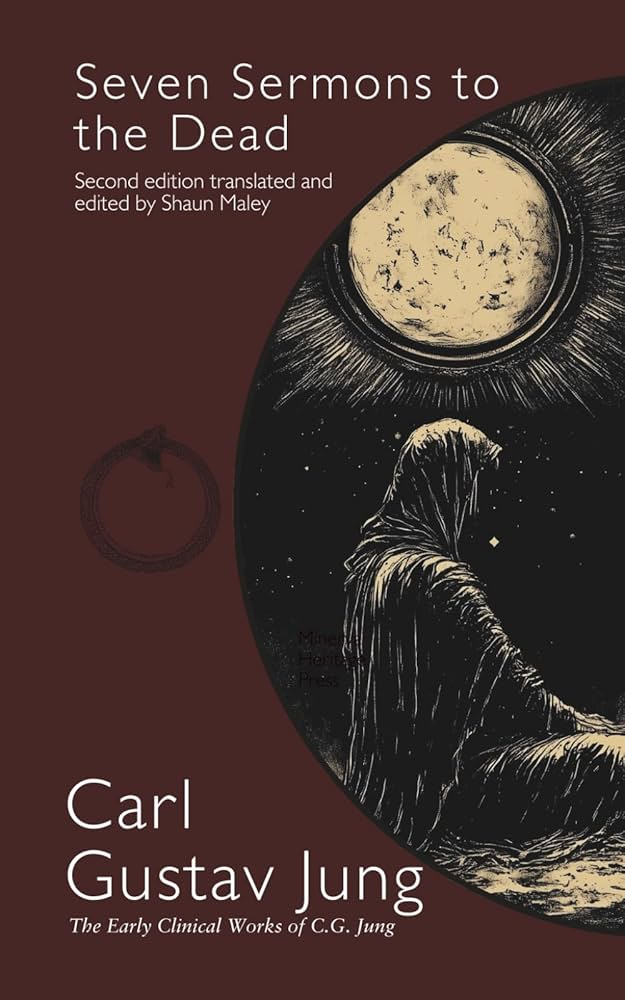
The session closed with a first-time attendee, Nikola, raising apparent contradictions in Jung's Seven Sermons to the Dead — between the monstrous, indifferent Abraxas and the inner divine creator that earths itself within man.
Bernardo's response centred on circumambulation — Jung's deliberate method of walking around an idea from multiple perspectives, rather than exposing it linearly. What looks like contradiction from one angle is simply a different face of the same thing seen from another.
He also contextualised the Seven Sermons within Jung's years of crisis and breakdown following his rupture with Freud — a period of psychotic openness to the collective unconscious, before he had the conceptual tools to understand what was erupting in him. Everything Jung wrote from 1922 until his death in 1961, Bernardo suggested, was an elaboration of what came to him in that dark period.
We also discussed
- The difference kinds of logic and where they break down
- Why Analytic Idealism does not accept the valid intuition that metacognition is fundamental
- How Mind at Large actively gestates our emerging individuality
The next session will be on maths and archetypes — a fitting continuation of themes that surfaced today.
I look forward to watching the always inspiring conversation!
With appreciation,
Amir