
Maths & Archetypes
18th March Q&A with Bernardo Kastrup hosted by Nour. 7-9pm UK / 8-10 CET / 3-5pm EST
Please note changed date and time for this meeting:
Wed 18th March 2026
7-9pm UK / 8-10 CET / 3-5pm EST
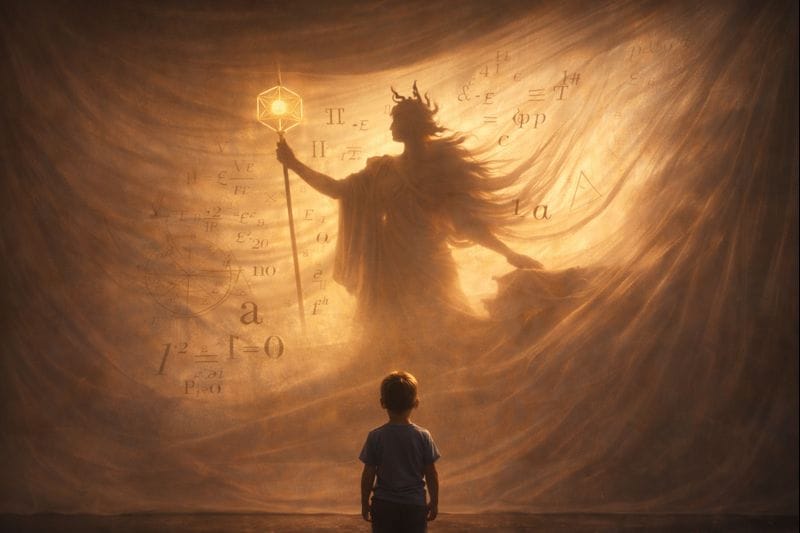
Have you ever stopped to wonder why numbers work? Not just in the sense of adding up your grocery bill, but why does the same mathematics that a Greek philosopher scribbled in the sand two and a half thousand years ago turns out to describe the movement of galaxies, the behaviour of quantum particles, and the curvature of spacetime?
That's not a small question. It's one of the deepest mysteries in all of human thought , and it's exactly what we're going to explore together.
It all starts with the ancient Greeks. Pythagoras, in the 6th century BCE, had a radical idea: that the universe at its core isn't made of fire or water or earth , it's made of numbers. Mathematical relationships, he believed, were the skeleton of reality itself. A few centuries later, Plato took this even further. He argued that perfect mathematical objects - a truly perfect circle, a truly ideal triangle - don't exist in the messy physical world. They exist in a higher realm of pure forms, and the world we see is just an imperfect shadow of that deeper reality. Sound wild? Plenty of mathematicians and physicists today still quietly believe something very similar.
"The book of nature is written in the language of mathematics." - Galileo Galilei
Fast forward two thousand years, and mathematics explodes in scope. Newton and Leibniz invent calculus. Cantor discovers that infinity comes in different sizes. And then, in 1931, a 25-year-old Austrian logician named Kurt Godel dropped what many consider the most unsettling result in the history of mathematics: his Incompleteness Theorems. In short , he proved that within any logical system powerful enough to do basic arithmetic, there will always be true statements that cannot be proved. Always. No matter how good your system is. Mathematics, it turned out, could never fully justify itself from the inside. If you want to get a feel for why this is so strange and beautiful, this Veritasium video is one of the best explanations I've come across , I genuinely recommend watching it before the session.
So why does any of this matter for our discussion?
In 1960, a physicist named Eugene Wigner wrote an essay that has never stopped haunting scientists and philosophers since. He called it "The Unreasonable Effectiveness of Mathematics in the Natural Sciences" and his point was deceptively simple: mathematicians routinely develop abstract ideas purely for the love of it, with no practical purpose in mind. And then, decades later, physicists discover that those exact ideas describe the real world with uncanny precision. Why? How?
"The miracle of the appropriateness of the language of mathematics for the formulation of the laws of physics is a wonderful gift which we neither understand nor deserve." ~ Eugene Wigner
Thinkers like Roger Penrose hint at something profound , that mathematical structures are genuinely real, that they exist independently of human minds, and that doing mathematics is a form of discovery, not invention. Others, like Max Tegmark, go even further and suggest that physical reality is a mathematical structure , that the universe isn't just described by maths, it is maths. There's a great series of short interview clips exploring exactly this question on Closer to Truth featuring Penrose, Michio Kaku, and others , well worth a browse.
And this is where Bernardo Kastrup comes in
Bernardo approaches all of this from a different, and I think genuinely exciting direction. Rather than asking "why does mathematics describe the physical world?", he asks us to question whether the physical world, as we've been taught to understand it, is even the right starting point. In his philosophy he argues that consciousness is the fundamental fabric of reality, and that what we call the "physical world" is how that universal consciousness appears when we observe it from the outside. If that's true, then maybe the reason mathematics feels so deeply woven into nature is that mathematics is the structure of mind itself , and nature is an expression of mind.
"Mathematics, rightly viewed, possesses not only truth, but supreme beauty , a beauty cold and austere, like that of sculpture." Bertrand Russell
The questions we'll be sitting with together are:
- Why does maths describe reality so well , is this a clue about the nature of reality itself?
- Are mathematical structures something out there, waiting to be discovered? Or tools our minds create to make sense of experience?
- Could maths be, in some sense, the grammar of consciousness?
- Do mathematical archetypes constrain what kinds of universes are even possible?
Suggested watching / reading before the event
You don't need to do any preparation to join , but if you're curious and want to get in the mood, here are a few things I found genuinely engaging:
- Math Has a Fatal Flaw , Veritasium on Gödel's incompleteness theorems. Accessible, mind-bending, only 34 minutes.
- Why the Unreasonable Effectiveness of Mathematics? , Closer to Truth, featuring Roger Penrose, Michio Kaku, and others.
- Wigner's original essay , only 10 pages, free to read, and remarkable for how clearly it poses the puzzle even if you skip the technical parts.
Gödel's theorems explained accessibly , a lovely piece in Quanta Magazine that needs no maths background.
I look forward to seeing you there!
Nour
Asking questions
Everyone is welcome to propose questions using the comments section below.
Questions are selected based on relevance and audience vote. As such, make sure to write your question so that most can understand what you mean!
- Give it a short CLEAR TITLE in capital letters.
- Write an optional short description of what your question is about.
- Share further reflections below if you want, but if selected, aim for brevity when asking to help the flow of the discussion.
Also make sure to read the other questions and 'heart' the ones you are most curious about!
Zoom Room
7-9pm UK / 8-10 CET / 3-5pm EST