
Mathematics, Apollo, Dionysus & Truth
Reconciling the unreasonable effectiveness & limits of maths | 18th March 2026
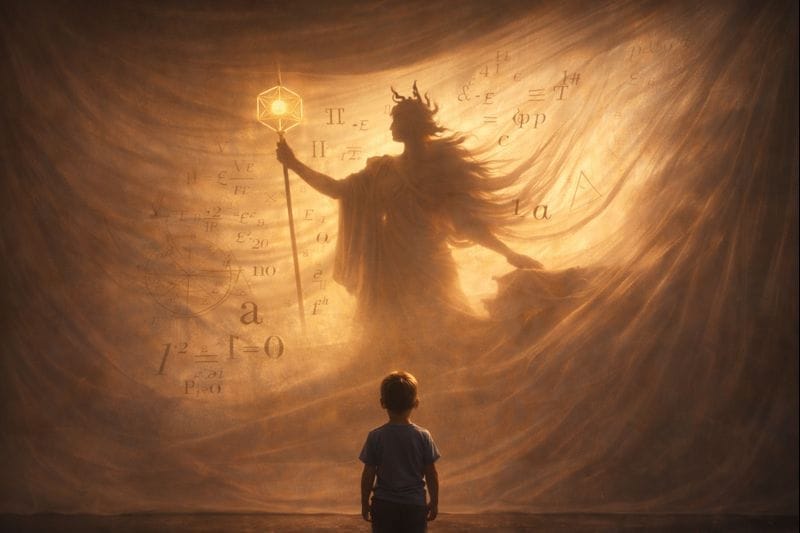
What a session. Honestly, I'm still thinking about it.
Bernardo reconciled two incredible features of mathematics: its unreasonable effectiveness, and its proven incompleteness, taking questions from this page which we revisit next week:
 Nour Elhuda Zuraiki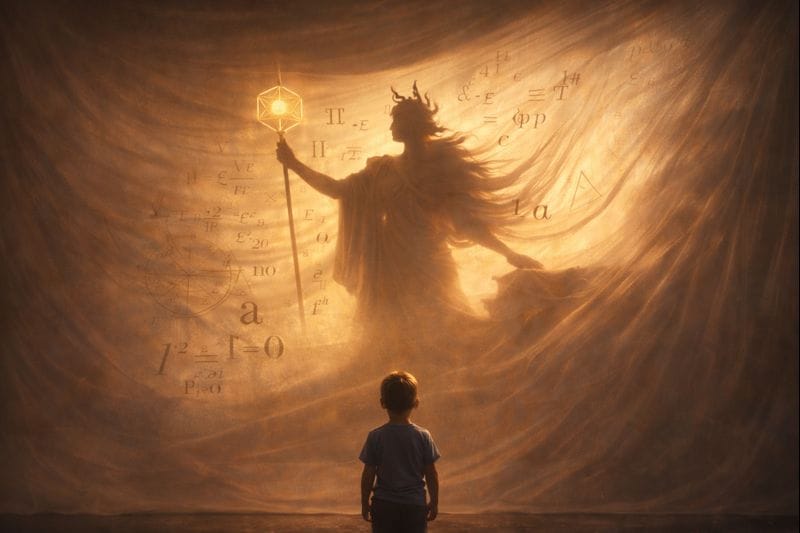
For Bernardo, whilst mathematics has special status amongst the instruments of science, it is not a window into the deepest nature of reality. It is precise and powerful, but ultimately confined to the phenomenal, to the world as it appears.
This suddenly made Gödel's observations on its limitations feel less like a dry logical curiosity and more like a profound confirmation: even from within mathematics itself, there is a proof that truth exceeds what structure can contain.
The system points beyond itself. It cannot close.
If mathematics only ever describes the dashboard representations, then its unreasonable effectiveness stops being quite so mysterious. Of course the instrument of science describes the world of appearances well, that's exactly the world it was forged in. The real mystery lives one layer deeper, in what the noumenal actually is, and whether anything in us can reach it.
Even analytic idealism is fundamentally Apollonian:
philosophically, or logically speaking, (and the observant ones amongst you will have already understood that) everything I do is Apollonian. The whole of analytic idealism is Apollonian, and therefore fundamentally incomplete.
It offers the most rigorous rational framework we have for that attempt. But the territory, it seems, remains beautifully, stubbornly beyond our reach, perhaps better illuminated by poetry, prayer and intuition.
As such, we ended the session with a poem read and authored by Reuben Hunt and included below, that echoed several themes. Some things are better felt than explained. Thank you Reuben.
We also discussed:
- Why nature obeys the psychological intuitions of logic: to deny them is to deny your own existence
- Why Apollonian projects have a psychological trap.
- Russell and Whitehead's Principia Mathematica, the 200-page proof that 1+1=2, and why their project of grounding all mathematics in logic was eventually shown by Gödel to be untenable
- The cosmic itch: the impossibility of nature stepping outside itself to fully describe itself gives rise to the entire game of existence?
- Why the self-reference problem is actually worse under analytic idealism than physicalism — because under idealism, everything is potentially self-referential; nothing can be isolated from the observer
See you next week, where we'll continue with questions on archetypes :)
With love,
Nour
PS. Escher's Drawing Hands two hands, each drawing the other into existence, is the perfect image to sit with when thinking about Gödel, a system that reaches back and touches its own foundations, only to find it can never fully grasp them.
Rueben's Poem
In a dank and rancid dream
I had a thought - my eyes agleam
Was a revelation nigh?
There split a gloom across the sky
I looked upon a ring of stones
And heard sepulchral baritones
There was I amidst a mire
That festered like a fell desire
Tendrilled vines spread o'er the lands
And lithely poised their creaking hands
The stinking guck beneath my weight
Began to spume and suppurate
Then I saw, to my disgust
A creature standing in a gust
A crooked shadow leapt, it seemed
From this bent and gangling fiend
Ashen figures filled the henge-
Their woeful dirge a dour wenge
The creature then aglare with glee
Turned its glowing lamps to me
And as I loft my old guisarme
The creature mimicked with its arm
For it had been a dreadful lie
The creature, then I saw, was I
As I looked down at my state
My sour, wretched, pointless fate
I opened once my doors, bereft
There was truly nothing left
Bind me up and sink me deep
Give the earth my bones to keep
So as I rot, my whispers weep
That I should sleep, and sleep
And sleep
by Rueben Hunt