
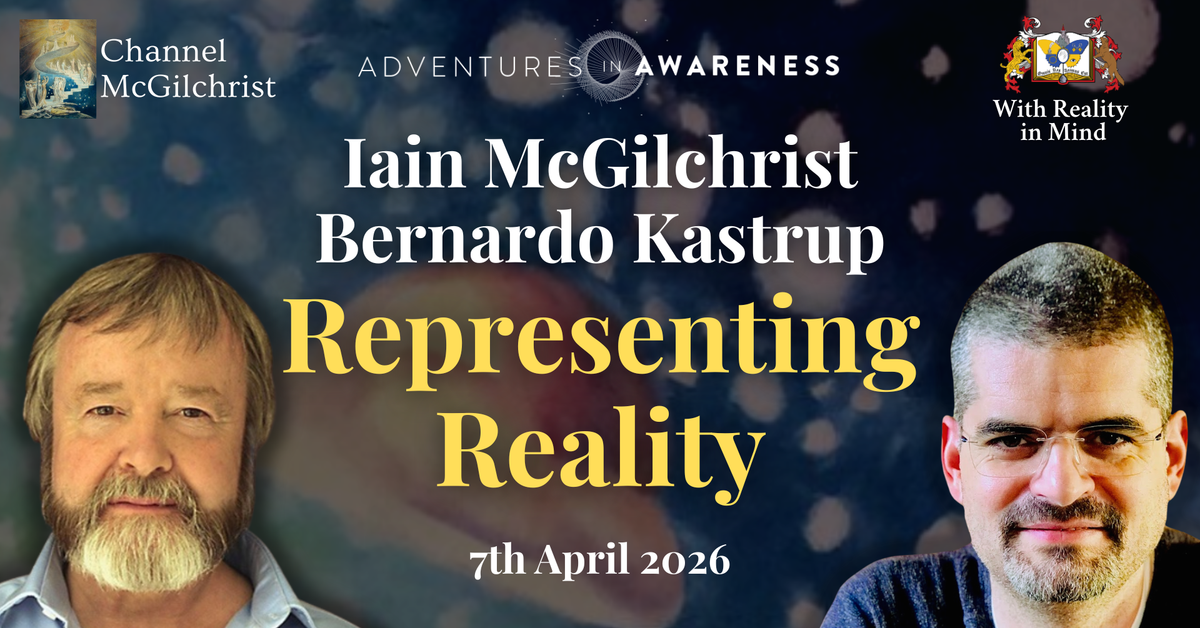
Iain McGilchrist, Bernardo Kastrup: to perceive is to participate in reality
On the dashboard, the daimon, & if time is frames or flow | 7th April 2026
Hey %recipient.firstname%,
In this deep conversation, Iain and Bernardo share their arguments for idealism, clear up misconceptions about ‘the dashboard of perception’ and compare their views on time. (For Bernardo it is an illusion; for Iain it is real, a continuous flow indicative of the unity of nature.)
They also shared their personal experiences of surrendering to their daimon - the real and often demanding impersonal force in their lives whose meaning is often only revealed in retrospect.
Perhaps most important is where they most align: consciousness is primary, and to perceive is to participate in both the purpose and unfolding of reality.
They agree that to rely on 'emergence' for how matter gives rise to experience is pure hand-waving. To evoke complexity ignores the facts: up to 80% of neurons are in the unconscious cerebellum, and there are extraordinary cases of conscious experience in humans with virtually no brain.
But can we know the world as it is?
Even if granting primacy to consciousness, it isn't clear if we can know reality as it is. Is perception merely a dashboard representation of an unknowable world, or are we embedded in reality in ways that are immediate and profound?
For both Iain and Bernardo, we are parts of a wider field of consciousness. But for Bernardo, this field's inner experience is represented to us on a dashboard we could call our 'screen of perception.' And this does separate us from the world as it is to itself.
But it also imbues experience with incredible meaning; every rock, tree and supernova represents a rich inner life that we can guess at by virtue of knowing our own inner life.
A real encounter
For Iain, however, the dashboard metaphor is too mechanistic, implying data that could be measured by a machine. Reality is not hidden behind a dashboard; it is an experience in which we're embedded:
I'm wanting to get towards is this idea of a very real contact being made between my consciousness and that field of consciousness: And it's not just like reading a dial, it's actually perceiving something that has qualities, and the qualities are true.
So, whatever it is out there, and whatever it is in me, are producing something together... It is a real encounter, and it's out of that encounter that all the experiential world that we know, including the world of science, comes
Perception, imagination & participation
Bernardo agrees, there are limits to the dashboard metaphor. If we really take in the forms and shapes of the world, they can evoke in us the deepest archetypes of nature. The universe becomes a living symbol charged with meaning.
For Iain, if we regard our perceptions of the world not as mere representations, but rather look so deeply into them that we are "actually looking through them," we arrive at a deeper experience of reality.
This requires a form of imagination that is the opposite of fantasy. As such,
"Imagination is not just something that's used by artists and poets. It is something we use all the time when we really make contact with reality."
It is moments like these that made this such an inspiring conversation, tangibly shifting my experience the following day.
I would love to also hear about your experience of engaging!
With appreciation,
Amir
P.S. next week we discuss Bernardo's book More than Allegory so make sure to get your copy and prep your questions.
Also discussed
- Divergent views on time
- Brain hemispheres and analytic idealism
- Art, mythology and Christianity
- Owen Barfield: Saving the Appearances