
Meditation & Enlightenment
The power of resonance to change your mind

This session is to discuss the power of meditation and sustained directed thought, as described in Chapter 6, "The Oscillating Membrane Metaphor," in Why Materialism is Baloney.
I highly recommend you get the book and read the whole chapter, but I've copied the most relevant section below, "Can the ego transcend its limitations?", with Bernardo's permission.
Bernardo often uses the metaphor of an ocean for the mind, but in this chapter he invites us to consider a different metaphor, and to imagine the substrate of mind to be like a membrane that can vibrate.
"Naturally, we can no longer visualize experiences as ripples, for the membrane is not a fluid. Imagine instead that experiences are vibrations of the membrane. The qualities of experience now correspond to the specific patterns of vibration of the membrane."
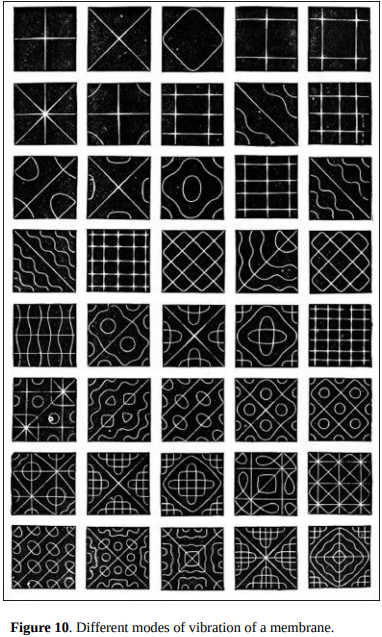
Even a two dimensional membrane can vibrate in many configurations, but we're invited to imagine mind as a multi-dimensional membrane that could account for the incredible complexity and nuance of experience.
Below are extended excerpts from this chapter, with videos and images sourced by me from the internet, and not part of the original book:
Imagine yourself pushing a child on a swing. The swing moves repetitively back and forth, which in essence is just a slow vibration. To get the swing to go far and high you need to push it at the same pace that it naturally ‘wants’ to sway at. If you push it too fast or too slow you will disrupt the swing’s vibration instead of contributing to its buildup. But, if you push it just right, your own movements will resonate with the movements of the swing, amplifying the latter. This, in essence, is resonance.
To put it more formally, resonance happens when the stimulus applied to a vibrating system has the same frequency as one of the system’s natural modes of vibration. The swing has a natural mode of vibration; that is, a certain pace at which it naturally ‘wants’ to sway. If you apply a stimulus to it with that same frequency, and at the right time, it will sway increasingly high. You don’t even need to apply much force, so long as the pace is right. The energy you apply each time you push contributes cumulatively to the movement of the swing. But, if you apply the stimulus at the wrong frequency, the energy application will conflict with the movement of the system.
A dramatic illustration of the power of resonance occurred in 1940, when the first Tacoma Narrows Bridge in Washington State, USA, collapsed because of a mild 42 mph (68 km/h) wind. It turned out that the wind had a frequency that matched almost perfectly the natural mode of vibration of the bridge, so they resonated. The energy of the wind began feeding slowly but cumulatively into the vibration of the bridge, just like a person gently pushing a swing at the right pace. The bridge then began to sway harder and harder, to the horror of people frantically abandoning their cars and running off the bridge. Eventually, the entire structure came apart and fell into the Tacoma Narrows. The entire event was caught on tape. Fortunately, nobody perished.
Through resonance, the bridge acquired and amplified the vibration of the wind. This is the key point about resonance that we will need later on: a system can acquire and amplify the vibration of an external stimulus if they resonate, much like a piano begins to vibrate when an appropriate tuning fork rings nearby.
Can the ego transcend its limitations?
Positing the primary cause – the energetic action of freewill – to be centralized somewhere or unevenly distributed over the membrane of mind would require unjustified new assumptions. Instead, we must take freewill to be a property evenly distributed throughout the membrane of mind. But then you might ask: ‘If freewill is evenly distributed, then the ego has it. And since freewill applies to both vibration and structural reconfiguration, why can’t the ego change its own structure at will?’ If the ego could do that, the psyche would be able to transcend space, time, and empirical reality as a whole. Who wouldn’t want that? Yet, not many of us seem able to do it. So what’s wrong?
The first thing to consider is that the ego, whose partial image, as we’ve seen, is closed-cycle neural processes in the brain, is hosted by a larger structure – namely, the rest of the body – that is not under the full control of egoic will. You can move and use your body within certain limits but you can’t, for instance, get taller or skinnier at will, or stop pain on command, or avoid all illness, etc. Indeed, the rest of the body is a partial image of the ‘personal unconscious’ – that is, of the underlying protrusion – not of the egoic loop per se. That’s why we say that we ‘have’ a body, instead of saying that we ‘are’ a body. The fact that it is hosted by this body poses strong boundary constraints on how far the ego can go, even in principle, in altering itself through exercising its own egoic will. Furthermore, the body itself – including the ego – is hosted by a yet broader region of mind that we call the universe. This broader region operates according to patterns and regularities – that is, the ‘laws of nature’ – that are also outside the control of egoic will. So the scope of possibilities for the ego to change itself is limited to begin with, since it is inserted in a context that it cannot fully control, and which poses strict boundary constraints on the ego itself.
All this said, there is evidence that some people can develop psychic abilities beyond anything ordinary. There is evidence that some of us can achieve what the culture has come to call ‘enlightenment’: a state of mind that allows one to see a deeper reality, beyond ordinary egoic limitations. There is evidence that some of us are able to transcend the plague of egoic neuroses. And there is no doubt that very few of us wouldn’t like to get there too. So why can’t we all?
Here is my answer: the ego is the limited patterns of vibration entailed by a certain loop structure. It is the patterns of thought, feeling, and perception that arise within that particular structure. As such, it is fair to say that the ego is the structure. Therefore, from the ego’s perspective, changing the structure too much means dying, insofar as it entails ceasing to be what it is. Although, in principle, it should have the freedom to carry out this action, the ego simply doesn’t want to. Precisely because it has freewill, it freely won’t. To avoid suffering, you may often think that you want to be ‘different,’ but that doesn’t mean that your ego wants to become something else. In reality, what you really want is to stop suffering as yourself, not to abandon your current sense of identity. After all, it doesn’t help if it is someone else who stops suffering!
Another point to consider is how much the egoic structure can be altered without this alteration turning into the process we call physical death. After all, we know empirically that the psychic structure – whose partial image is the body, including the brain – is a very delicate system. A significant change in the egoic structure would entail as a significant change in the image we call the brain. And we all know that too significant a change in that image – I will refrain from graphical descriptions here – correlates with physical death. In other words, large disruptions in the partial image that we call a brain reflect large disruptions in the ‘whirlpool’ of the psyche (remember?), perhaps to the point that it could no longer sustain itself and would dissipate instead.
So, does this all mean that most of us are condemned to the egoic prison, with all its trappings and grasping, until physical death? Not necessarily.
The ego has no problems using its freewill – its portion of the primary cause’s mental energy – to try and improve its own feelings and thoughts. After all, we all want to have better feelings and higher thoughts without ceasing to be who we are. In the metaphor, this corresponds to choosing which ones, among the many modes of vibration supported by its loopy structure, the ego wants to vibrate in. No significant structural reconfiguration is entailed and, thus, no threat to the ego. All it is trying to do is to become the best version of itself that it can be. Your very reading of this book likely reflects an attempt by your ego to do just that.
But now an interesting and unexpected effect sneaks into the picture, outside the ego’s radar screen: vibrations can dramatically affect the configuration of the structures where they take place. The original Tacoma Narrows Bridge is a clear example of this: after the resonant vibrations taking place in it did their job, the bridge ended up looking a little different. Theoretically, in fact, there are always resonant patterns of vibration that can change and even destroy any structure hosting them.(126)
Ordinarily, one disperses one’s mental energy by exciting multiple, interfering modes of vibration within the egoic loop. The resulting vibrations, thus, never build up to disruptive levels: the different patterns partially cancel each other out. However, each egoic loop has the freedom and the potential will, within the modes of vibration it is bound to, to channel its energy into a single resonant pattern. When one focuses one’s thoughts and feelings this way, there is no cancelation, but a cumulative build-up of vibration. The result is akin to continuously using all of one’s power to push a swing at just the right pace: eventually something disruptive will happen (and you don’t want a child to be sitting on the swing at that moment), just as it did with the original Tacoma Narrows Bridge.
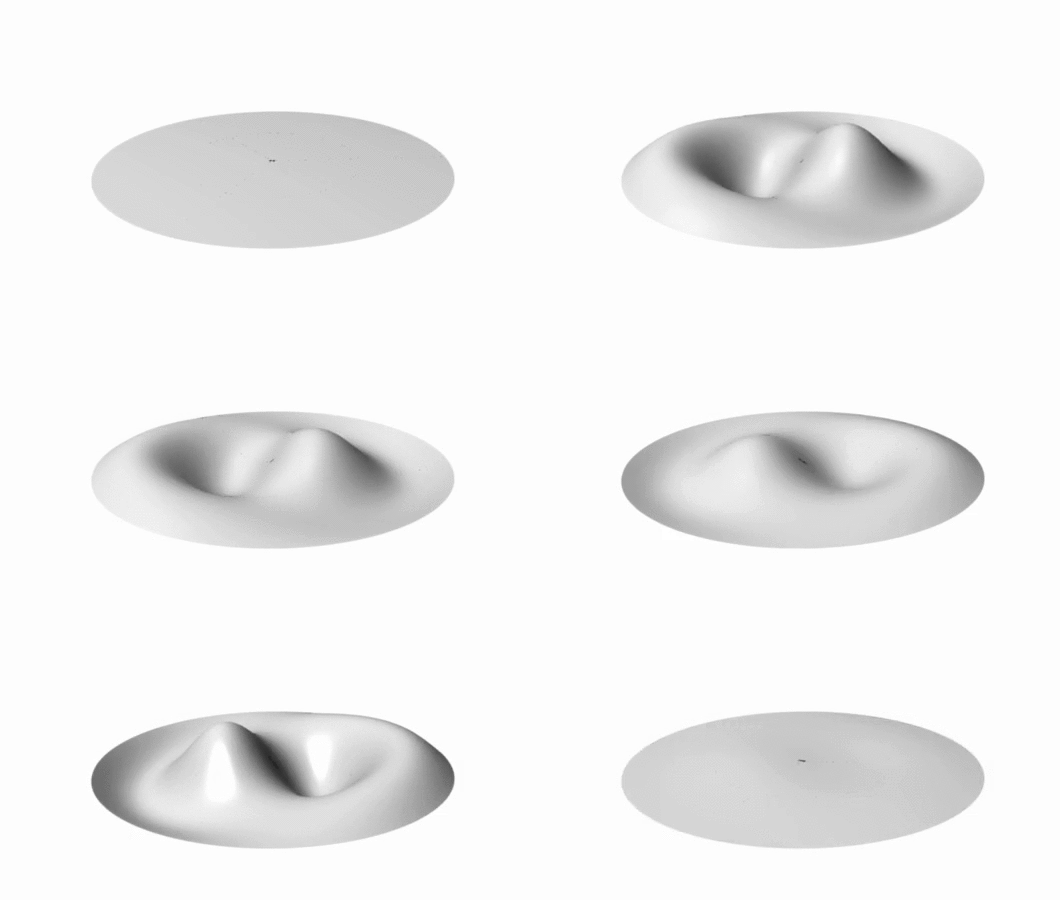
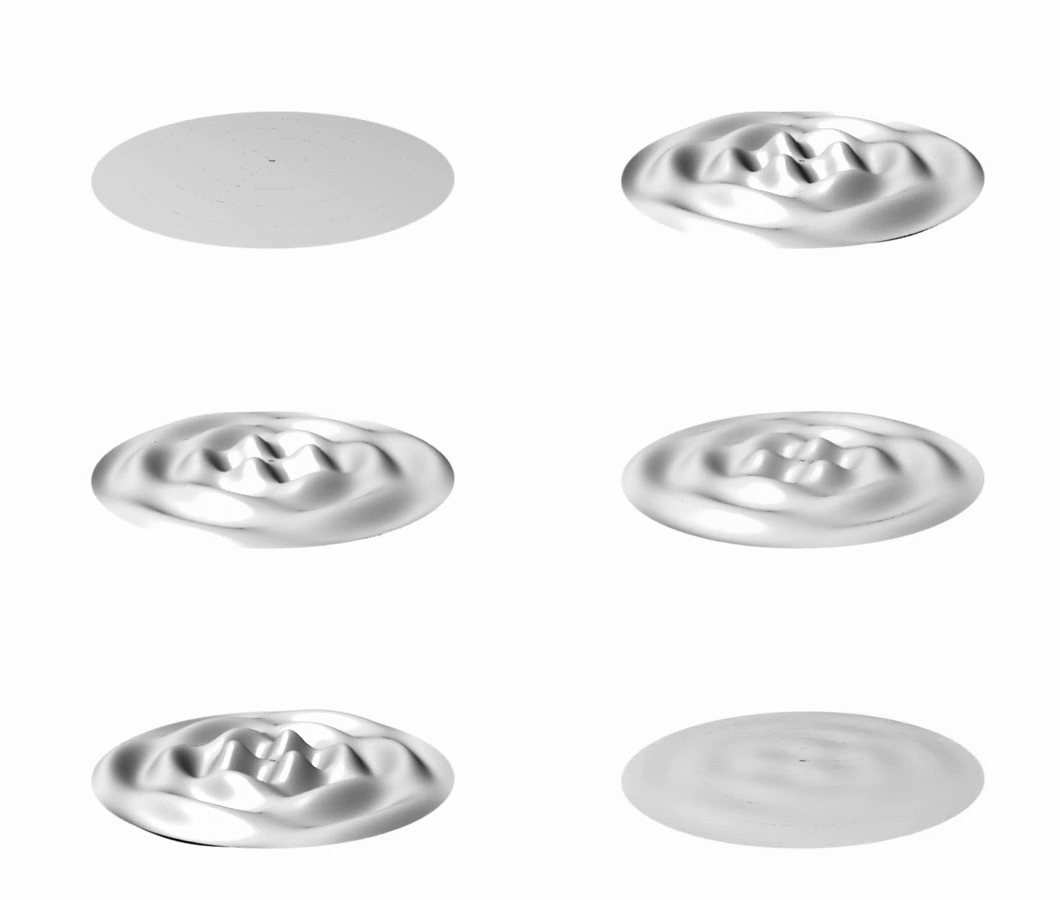
Even though the ego is applying its freewill to excite vibrations alone – not structural reconfigurations – the process will end up disrupting the structure of the individual’s psyche. And when it does, the psyche will have a new structure and, therefore, support new modes of vibration! Without really intending to do it directly, the ego will have transformed into something else. Whether this change is positive or not depends on the process. Mental energy can be focused on certain modes of vibration through, for instance, meditation. In this case, the changes tend to be positive by design, since the individual chooses where the focus goes. But in other cases, like in Obsessive-Compulsive Disorder (OCD), the reinforcement may not go in a desirable direction.
If these considerations are correct, our individual thoughts and feelings can potentially change our psychic structures and alter the set of constraints that our experiences are ordinarily bound to. Since brains are partial images of these structures, it is conceivable that our thoughts and feelings could change the anatomy and ‘wiring’ of our brains, an effect neuroscience has come to call ‘selfdirected neuroplasticity.’ And indeed, there is strong empirical evidence that the effect happens. For instance, experiments have been performed in which patients suffering from OCD have been able to physically alter their own brain anatomy and neural ‘wiring’ – thereby curing themselves – simply by focusing their thoughts. 127 Several other studies have been done showing analogous results. 128
As I elaborated upon in my earlier book Rationalist Spirituality, such results are difficult to make sense of under materialism, requiring contrived and promissory explanations. As Dr. Jeffrey Schwartz, of the UCLA Neuropsychiatric Institute put it, ‘the demand that the data be understood solely from the perspective of brain-based causal mechanisms is a severe and counterintuitive constraint.’ 129 In contrast, the observed effect is natural and explainable in a very intuitive manner under the idealist interpretation described in this book.
126 Douglas Hofstadter, in his magnificent book Gödel, Escher, Bach, told a little tale titled Contracrostipunctus that wonderfully illustrates this point (Hofstadter 1980, pp. 75-81).
127 Schwartz and Begley (2004).
128 A discussion of many of these studies can be found in Schwartz, Stapp, and Beauregard (2005).
129 Schwartz, Stapp, and Beauregard (2005), p. 1311.
Asking questions
I hope you found this section as intriguing and inspiring as I did!
Everyone is welcome to propose questions relevant to the above theme, using the comments section below.
Questions are selected based on relevance to the discussion, available time, and participant's votes. As such, please make sure to write your question using accessible language!
- Provide a short CLEAR TITLE in capital letters.
- Write an optional short description of what your question is about.
- Share further reflections below if you want, but if selected, aim for brevity during the meeting to help the flow of the discussion.
Also make sure to read the other questions and 'heart' the ones you are most curious about!
Zoom room and date to be determined.